


When a child is injured because of another person’s negligence, the child may have a right to compensation even though the child cannot manage a legal claim independently. A parent, guardian, or another appropriate adult can generally act on the child’s behalf, but the claim belongs to the child and must be handled in the child’s best interests.
This guide explains who may file a Chicago personal injury claim for a minor, the Illinois deadlines that may apply, how courts review a child’s settlement, what compensation may be available, and the evidence families should preserve. Because deadlines and settlement procedures depend on the facts, families should obtain legal advice before relying on a general rule.
Child Injury Claims at a Glance

- An appropriate adult, often a parent acting as the child’s next friend, can pursue the claim on the child’s behalf.
- You do not have to wait until your child turns 18 to pursue a claim.
- Filing deadlines depend on the type of claim and the parties involved.
- Resolving a minor’s claim involves court oversight; a parent’s agreement alone should not be treated as sufficient.
- Compensation allocated to the child is for the child’s benefit.
Who Can File a Personal Injury Claim on Behalf of a Child?
A parent commonly brings a lawsuit as the child’s “next friend.” This means the parent acts on the child’s behalf in the litigation. It does not mean the parent owns the claim or can use the child’s compensation freely.
A guardian or another appropriate representative may act instead, depending on the circumstances. An attorney can determine how the lawsuit should be filed and whether a court appointment is needed.
The adult’s interests must be consistent with the child’s interests. If a parent may share responsibility for the accident, an attorney should assess whether someone else needs to represent the child’s interests. A parent who is not an attorney generally cannot provide legal representation for the child in court.
Once the appropriate representative is identified, an attorney can investigate the incident and determine whether a lawsuit is necessary. Our guide to the steps involved in filing a personal injury lawsuit in Illinois explains the broader process.
What Is the Filing Deadline for a Child Injury Claim in Illinois?
For many Illinois personal injury claims, a person injured before turning 18 generally has two years after their 18th birthday to file a lawsuit. However, the child’s 20th birthday is not a universal deadline for every case. The type of claim, the defendant, and any exceptions must be reviewed. The general provision is Illinois statute on deadlines for minors and people with legal disabilities.
Medical Malpractice Claims Have Different Rules
Illinois has a separate limitations provision for medical malpractice involving minors under Illinois statute on medical malpractice filing deadlines. Do not assume that a birth injury, delayed diagnosis, or surgical error follows the ordinary personal injury deadline. An attorney should review the treatment date, the child’s age, discovery of the injury, and any applicable exceptions.
A Parent’s Related Claim May Have a Different Deadline
Expenses associated with a child’s injury can raise separate questions about who has the right to recover them. A parent’s own claim should not automatically be assumed to receive the same deadline extension as the child’s claim. Cases involving public entities or other special circumstances also need individual review.
An extended filing period does not preserve evidence. Surveillance footage may be overwritten, witnesses may become difficult to locate, and damaged equipment may be repaired. Early investigation also helps document how the injury affects the child’s treatment and daily life.
How Are Child Injury Settlements Approved in Chicago?
Parents should expect court involvement when resolving a minor’s personal injury claim. Reaching an agreement with an insurer is only part of the process.
Cook County’s published guidance for minor estates includes procedures for petitions to approve settlements. Supporting materials can include a description of the injuries, accident reports, medical records, and an explanation of why the proposed settlement is appropriate. Where treatment continues, information about the child’s prognosis may also be required. See the Cook County Calendar 1 minor-estate standing order.
The procedure depends on where the case is pending and whether another court has already approved the settlement.
Who Controls the Child’s Settlement Money?
The child’s funds must be handled according to the court’s order. A restricted account may be required, and parents should not assume they can withdraw money for ordinary household expenses. Cook County’s minor-estate procedures address proof of restricted accounts and court-approved payments. An attorney can explain the proposed arrangement and permitted access to the funds.
What Compensation Can a Child Injury Claim Cover?
A child injury claim should account for the harm already suffered and any supported future needs.
Financial losses, known as economic damages, may include treatment, rehabilitation, assistive equipment, and other injury-related expenses. An attorney must determine who is legally entitled to recover each expense.
The claim may also address non-economic damages, such as pain, disfigurement, and loss of normal life. These losses concern how the injury affects the child beyond its financial cost.
| Type of loss | What the claim may need to address |
| Medical treatment | Emergency care, surgery, medication, follow-up care, and reasonably necessary future treatment |
| Rehabilitation and assistance | Therapy, assistive devices, and ongoing care needs |
| Pain and suffering | Physical discomfort and its effects on daily activities |
| Scarring or disfigurement | Lasting changes in appearance |
| Disability or loss of normal life | Restrictions on activities the child would otherwise undertake |
| Future earning capacity | A supported reduction in the ability to earn income as an adult |
The same loss cannot be recovered twice. There is no standard settlement amount for a child’s injury. The evidence, long-term prognosis, legal responsibility, and available insurance or other recovery sources all matter.
What Do National Statistics Show About Child Injuries?
National data provides context for the types of injuries families may face. These figures cover the United States, not Chicago or Illinois, and do not establish fault or predict the value of an individual claim.
NHTSA recorded 1,019 traffic deaths among U.S. children ages 14 and younger in 2023, down from 1,130 in 2022. The graph shows the 2014–2023 series from one published report. Source: NHTSA Children: 2023 Data.
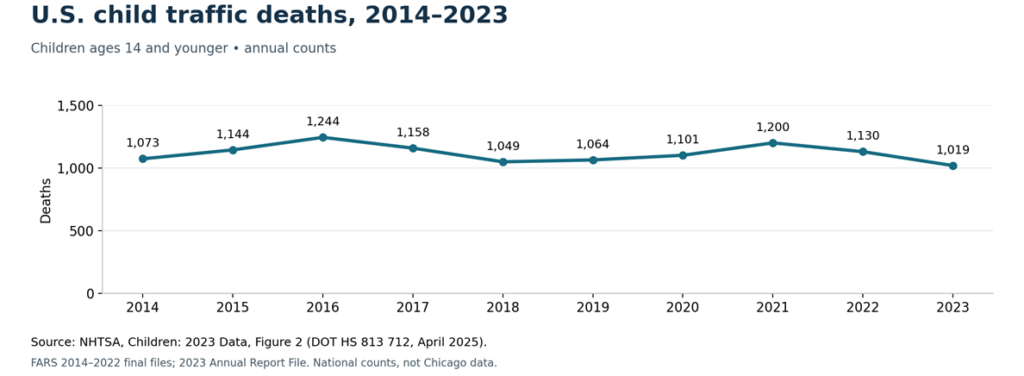
Annual national counts from the April 2025 report; 2023 uses the Annual Report File and may be revised in later releases. Of the 1,019 child traffic deaths in 2023, 770 were vehicle occupants, 171 were pedestrians, 41 were pedalcyclists, and 37 were other or unknown nonoccupants. Source: NHTSA Children: 2023 Data.
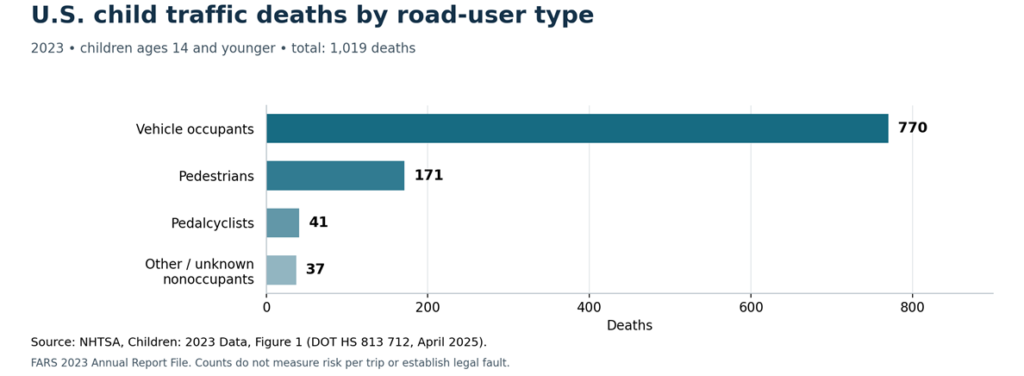
Categories sum to 1,019 deaths. Vehicle occupants include more than passenger-car passengers; these are counts, not exposure-adjusted risk rates.
Both graphs use the same age definition and report. They describe fatal traffic injuries only, not every type of childhood injury. National statistics do not establish fault or predict compensation in an individual claim.
Data Behind the National Graphs
The tables below provide the exact values shown in the graphs. All figures count traffic deaths among children ages 14 and younger in the United States.
Annual child traffic deaths, 2014–2023
| Year | U.S. child traffic deaths |
| 2014 | 1,073 |
| 2015 | 1,144 |
| 2016 | 1,244 |
| 2017 | 1,158 |
| 2018 | 1,049 |
| 2019 | 1,064 |
| 2020 | 1,101 |
| 2021 | 1,200 |
| 2022 | 1,130 |
| 2023 | 1,019 |
Child traffic deaths by road-user type, 2023
| Road-user type | U.S. child traffic deaths |
| Vehicle occupants | 770 |
| Pedestrians | 171 |
| Pedalcyclists | 41 |
| Other / unknown nonoccupants | 37 |
| Total | 1,019 |
The 2023 figures use the FARS Annual Report File; 2014–2022 figures use final files. Later releases may revise 2023 counts. These statistics cover fatal traffic injuries, not all childhood injuries.
How Common Are Child Traffic Fatalities in Illinois?
Illinois recorded 28 traffic deaths among children ages 14 and younger in 2023. Its child traffic death rate was 1.28 per 100,000 children, compared with 1.71 nationally. These statewide figures provide context for Chicago families; they are not Chicago-specific totals.
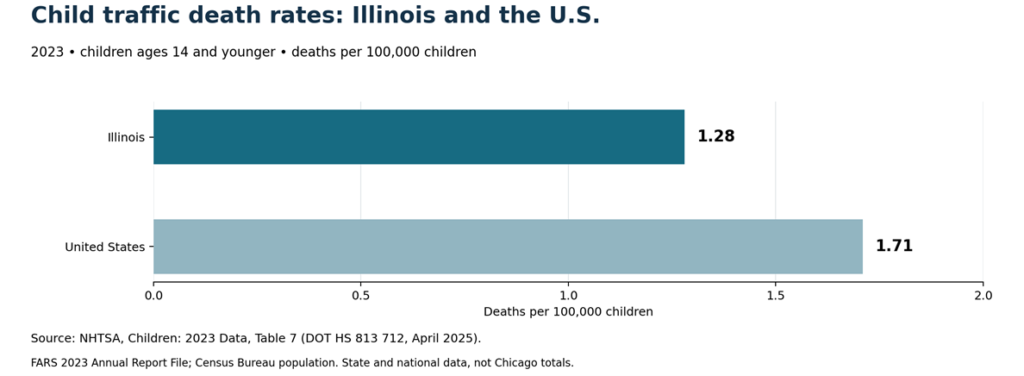
| 2023 measure (ages 0–14) | Illinois | United States |
| Traffic deaths | 28 | 1,019 |
| Child population | 2,196,077 | 59,498,481 |
| Deaths per 100,000 children | 1.28 | 1.71 |
How Do You Prove Liability for a Child’s Injury?
Many child injury claims are based on negligence. In these cases, the evidence must establish:
- Duty: The defendant owed the child a legal duty of care.
- Breach: The defendant failed to meet that duty.
- Causation: That failure caused the child’s injury.
- Damages: The child suffered harm as a result.
For example, a collision involving an injured child may require examination of traffic signals, witness statements, video footage, and medical records. An injury alone does not establish liability. Other claims can involve different legal requirements, so the investigation must address the circumstances of the specific incident.
What Types of Accidents Can Lead to a Child Injury Claim?
Traffic Accidents
Children can suffer injuries as passengers, pedestrians, or bicycle riders. Claims involving car accidents in Chicago may require a review of driver conduct, crash evidence, and applicable insurance coverage.
Dog Bites and Animal Attacks
An attack can leave a child with physical injuries, scarring, and lasting fear. Our page on dog bite claims in Chicago explains this type of case in more detail.
Medical Errors
Injuries involving diagnosis, medication, surgery, or childbirth require a separate assessment of the treatment provided. Learn more about how our attorneys evaluate medical malpractice claims.
Falls and Other Incidents
Unsafe property conditions, school or daycare incidents, recreational injuries, and swimming accidents may also warrant investigation. Depending on the circumstances, the evidence may raise questions about maintenance, equipment, access controls, or supervision. Responsibility is not automatic because an injury occurred at a school, business, or another person’s property.
Summary
A child injury claim is brought for the child’s benefit, and an appropriate adult may pursue it while the child is still a minor. Families generally do not need to wait until the child turns 18. However, the filing deadline depends on factors such as the type of claim, the parties involved, and the child’s age, so it should be confirmed promptly. Any settlement involving a minor will normally require court oversight, and the compensation must be protected for the child’s benefit. Recoverable compensation may cover medical expenses, rehabilitation, pain, disfigurement, loss of normal life, and supported future needs. Medical records, incident reports, photographs, witness information, and documentation showing how the injury affects the child’s daily life can help support the claim. Government statistics may provide useful context, but they do not establish negligence or determine the value of an individual case. Because every claim is fact-specific, an attorney should confirm the applicable deadline, identify the proper representative, assess liability, and review any proposed settlement before documents are signed.
Frequently Asked Questions About Child Injury Claims
Can I bring a claim before my child turns 18?
Yes. An appropriate adult can pursue the claim on the child’s behalf while the child is a minor. You do not need to wait for adulthood to investigate or take legal action.
What if an insurer says my child caused the accident?
That allegation does not settle the issue. An attorney should review the evidence and the rules applicable to a child’s conduct. The child’s age and the circumstances can matter.
Will my child have to testify?
Possibly, but not every claim reaches trial. Whether the child needs to participate in testimony depends on the disputed facts, the child’s age, and how the case proceeds.
Should I accept an offer while my child is still receiving treatment?
An offer should be evaluated against the medical evidence and anticipated future needs. Ongoing treatment can make those needs harder to assess. The settlement review should address the child’s prognosis and unresolved medical questions.
Schedule a Free Consultation With Our Chicago Child Injury Lawyers
At Attorneys of Chicago Personal Injury Lawyers, our legal team works diligently to protect your child’s best interests as we seek justice for your child. Contact our law firm to schedule a free case evaluation with a Chicago personal injury lawyer. Let us help you recover the compensation your child deserves for an accident or personal injury, call us today at (312) 766-4878.
