


After an injury in Chicago, practical decisions can affect both medical recovery and a possible claim. People often want to know whether they have a case, what evidence matters, how long they have to act, what an insurer may ask for, and whether hiring a lawyer is necessary. The answer depends on how the injury happened, who may be responsible, the available insurance, and the Illinois law that applies to the claim.
In general, a personal injury claim may exist when another person, company, property owner, professional, manufacturer, or public body caused harm through negligence or another recognized basis of liability. A valid claim still requires evidence connecting the responsible party’s conduct to the injury and the losses being requested. This guide answers common questions, but an attorney must review the facts and deadlines in an individual case.
What Should I Do After an Accident in Chicago, Illinois?

Accidents are scary and traumatic events. Many people are in shock or overwhelmed after an accident. Knowing what to do after an accident can help to keep you safe, improve your long-term prognosis, and help you get the most out of your personal injury claim.
Here’s a checklist of what to do after a Chicago accident:
Get medical care first, report the event to the appropriate authority or property owner, and preserve information before it disappears. The correct reporting step may be a police crash report, an incident report at a business, a workplace report, or a written notice to another responsible party. Do not delay necessary care while trying to document the scene.
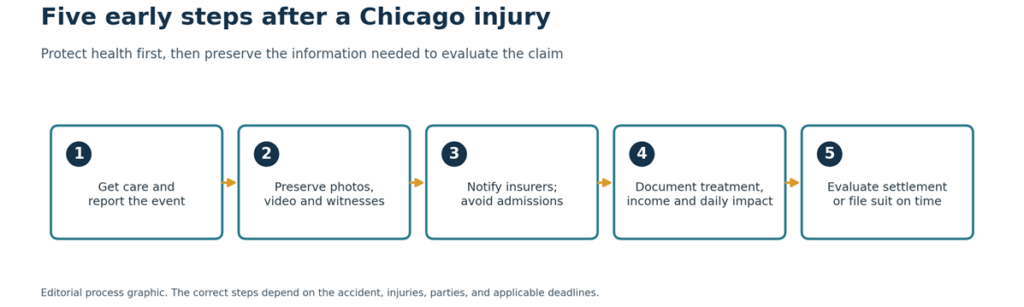
| Priority | Action | Why it matters |
| Health | Call 911 when appropriate and obtain prompt medical evaluation. | Treatment protects health and creates contemporaneous medical documentation. |
| Reporting | Create the correct police, business, workplace, or property incident report. | A dated report helps identify the event, parties, location, and witnesses. |
| Evidence | Preserve photographs, video, damaged property, witness details, and correspondence. | Conditions change and digital footage may be overwritten. |
| Communication | Give necessary factual notice, but avoid guessing, apologizing, or accepting blame. | Incomplete statements may later be used to dispute fault or causation. |
| Records | Track appointments, expenses, missed work, restrictions, and effects on daily life. | A claim needs support for both financial and non-financial losses. |
If the injury may involve a dangerous condition, defective product, commercial vehicle, public property, or serious permanent harm, early legal advice may help preserve evidence and identify parties before a deadline expires.
How Do I Know Whether I Have a Personal Injury Case?
A personal injury case usually requires a legal basis for holding another party responsible. In a negligence case, the injured person generally must prove that the defendant owed a duty of care, breached that duty, caused the injury, and produced legally recognized damages. Some claims use different rules, including strict liability, premises liability, product liability, medical negligence, or statutory duties.
An injury alone does not automatically establish liability. A useful case review asks: Who had control? What rule or duty applied? What did the person or organization do or fail to do? Would the injury have occurred without that conduct? What medical and financial harm followed? The firm’s guides to negligence and liability explain these concepts in more detail.
What Evidence Can Support a Personal Injury Claim?
Evidence should address both responsibility and damages. Depending on the event, useful evidence may include photographs, surveillance or dash-camera footage, police or incident reports, witness statements, maintenance and inspection records, electronic data, medical records, bills, wage records, tax documents, expert opinions, and a record of how the injury affects daily activities.
The strongest evidence is not always in the injured person’s possession. A business may hold surveillance video, a trucking company may hold vehicle and driver records, or a public body may control maintenance records. Preservation letters, public-records requests, subpoenas, and court discovery may be necessary. Read more about evidence in an Illinois personal injury case.
How Long Do I Have to File a Personal Injury Lawsuit in Illinois?
Illinois generally provides two years to begin an action for injury to the person, but the correct deadline can be shorter or longer depending on the defendant, claim type, age of the injured person, discovery of the injury, and other facts. The Illinois personal injury limitations statute states the general two-year rule, but it should not be treated as a universal deadline.
| Situation | General issue to review | Why prompt review matters |
| Ordinary negligence | A two-year limitations period commonly applies. | The triggering date and any exception must still be confirmed. |
| Local public entity or employee | A shorter limitations period may apply under the Illinois Tort Immunity Act. | The identity and status of the defendant may change the deadline. |
| Medical malpractice | Illinois uses discovery and repose rules with special provisions for minors. | Treatment dates and when the injury was discovered both matter. |
| Injured child | Minority may affect some deadlines, but not every related claim. | A parent’s expense claim and the child’s injury claim may be treated differently. |
| Wrongful death | A separate statutory framework applies. | The representative, underlying claim, and date of death require review. |
Waiting is risky even when time may remain. Evidence can be lost, witnesses can move, and insurance coverage can become harder to identify. Review the firm’s detailed guide to the Illinois statute of limitations for personal injury cases and obtain a case-specific deadline analysis.
Can I Recover Compensation if I Am Partly at Fault?
Yes, in some cases. Illinois uses modified comparative negligence. A claimant whose contributory fault is 50% or less may recover, but the award is reduced by that percentage. A claimant whose fault is more than 50% is barred from recovering under that rule. The Illinois Department of Insurance explanation of comparative negligence provides an insurance-claim example.
For example, a $100,000 damages finding reduced by 20% fault produces an $80,000 recovery before other case-specific deductions or issues. Fault percentages are not determined by a formula; they are negotiated, decided by a judge or jury, or affected by the available evidence. Learn more about contributory fault in Illinois.
What Damages May Be Available?
Compensatory damages are intended to address losses caused by the injury. Economic damages may include reasonable medical expenses, rehabilitation, medication, out-of-pocket costs, lost earnings, reduced earning capacity, property damage, and supported future financial needs. Non-economic damages may include pain and suffering, emotional distress, disability, disfigurement, and loss of normal life. A spouse may have a separate loss-of-consortium claim in appropriate circumstances.
Punitive damages are different. They are not available in every case and are intended to punish and deter qualifying misconduct rather than reimburse an ordinary loss. See the firm’s overview of damages available in Illinois personal injury cases and the explanation of economic damages.
How Much Is My Personal Injury Case Worth?
No reliable calculator can determine case value from the injury name alone. Relevant factors include the strength of liability evidence, comparative fault, diagnosis and prognosis, treatment history, permanent impairment, effect on work and daily life, prior medical history, credibility, available insurance, liens, venue, and the risks and costs of litigation.
Past verdicts and settlements may provide context, but they do not guarantee a similar result because the facts, defendants, coverage, evidence, and decision-makers differ. A supported valuation should separate past losses from future losses and should explain the evidence behind each category. Review the more detailed guide to factors that affect a Chicago personal injury case’s value.
How Are Pain and Suffering Damages Evaluated?
Illinois does not assign a fixed price to pain and suffering. The analysis may consider the type and duration of pain, treatment burden, activity restrictions, emotional effects, scarring, disability, interference with relationships, and whether symptoms are expected to continue. Medical records, testimony, photographs, contemporaneous messages, and specific examples of lost activities may help explain these non-financial effects.
Multipliers and per-day calculations sometimes appear in negotiations, but neither method automatically controls an Illinois case. The result must be supported by the evidence and circumstances. Read how pain and suffering damages may be evaluated.
Should I Speak With the Insurance Adjuster?
You may need to provide basic notice and factual information, but use care before giving a recorded statement, signing a medical authorization, estimating injuries, or discussing fault. The adjuster represents the insurer’s interests and evaluates whether the company owes payment under the policy. Early symptoms can change, and a broad authorization may seek records beyond the injury at issue.
Ask which insurer and claim the adjuster represents, obtain the claim number, keep copies of communications, and do not guess. If the request is unclear or the injuries are significant, legal advice can help determine what information is required and how to provide it accurately. The firm’s guide explains what an insurance adjuster does.
Should I Sign an Insurance Settlement Release?
A settlement release usually ends the right to pursue additional compensation for the released claim, even if symptoms worsen later. Before signing, confirm the payment amount, parties being released, claims covered, lien and reimbursement terms, confidentiality or non-disparagement language, indemnity obligations, and timing of payment. Do not assume a document is a routine receipt merely because an adjuster describes it that way.
A release should be reviewed together with the medical outlook and known insurance coverage. Learn more about personal injury settlement agreements.
Can I Recover if I Had a Preexisting Condition?
A preexisting condition does not automatically prevent recovery. The key question is whether the incident caused a new injury or aggravated an existing condition. The claimant must still prove causation and separate accident-related harm from unrelated symptoms as the evidence permits.
Complete medical history and consistent explanations matter. Prior records may establish the earlier baseline, while post-incident examinations and expert opinions may show a change. Concealing prior treatment can damage credibility; accurate disclosure allows the medical evidence to be addressed directly.
How Can a Chicago Personal Injury Lawyer Help?
A personal injury lawyer can investigate responsibility, preserve evidence, identify defendants and insurance, collect medical and financial records, analyze deadlines, consult experts, communicate with insurers, calculate supported damages, negotiate, file a lawsuit, conduct discovery, and prepare the case for trial. The work required depends on the case; not every claim needs every step.
Legal representation cannot guarantee a settlement or result. Its value is in applying the correct law, building an evidence-based claim, protecting procedural rights, and helping the client evaluate options and risks. See when to hire a personal injury lawyer.
How Much Does a Personal Injury Lawyer Cost?
Many personal injury lawyers use a contingency fee, meaning the attorney fee is calculated as an agreed percentage of the recovery rather than billed by the hour. The client should receive a written agreement explaining the percentage, litigation costs, how expenses are handled, what happens if there is no recovery, and whether the percentage changes if suit or an appeal is required.
Ask for an explanation of the fee using a sample settlement so the difference between the gross recovery, attorney fee, case costs, medical bills or liens, and net amount is clear. Review the guides to contingency fees and the cost of hiring a Chicago personal injury lawyer.
How Long Does a Personal Injury Claim Take?
There is no single Illinois timetable. A claim may take longer when treatment is ongoing, the prognosis is uncertain, several parties or insurers are involved, fault is disputed, coverage is limited, records are incomplete, experts are needed, or litigation becomes necessary. Resolving a claim quickly is not always beneficial if future treatment or lost earning capacity is still unclear.
| Stage | What usually happens | Common timing variables |
| Initial response | Medical care, reporting, claim notices, and evidence preservation. | Emergency needs, access to video, witnesses, and reports. |
| Investigation | Liability, insurance, medical causation, and damages are documented. | Multiple parties, disputed fault, missing records, and expert review. |
| Demand and negotiation | A supported demand is evaluated and offers may be exchanged. | Treatment status, completeness of documentation, and valuation disputes. |
| Litigation if needed | Pleadings, discovery, depositions, motions, experts, mediation, and possible trial. | Court calendar, discovery scope, motion practice, and expert schedules. |
| Settlement completion | Release review, lien resolution, check processing, and distribution. | Release language, reimbursement claims, and payment processing. |
The firm’s personal injury case timeline explains these stages in greater detail.
Will My Personal Injury Case Go to Trial?
Many cases settle without trial, including some that settle after a lawsuit is filed. Filing suit creates access to formal discovery and preserves a path to a court decision when the parties cannot agree. Whether a case reaches trial depends on liability disputes, damages evidence, coverage, settlement offers, legal rulings, and the client’s informed decisions.
A lawsuit should not be confused with a guaranteed trial. Settlement discussions may continue during discovery, after expert reports, at mediation, during motion practice, or near trial. Compare an insurance claim with a personal injury lawsuit and read what may affect whether a case goes to trial.
What if a Child Was Injured?
A child’s claim must be handled for the child’s benefit. An appropriate adult may pursue the matter while the child is a minor, and a settlement commonly requires court oversight and protection of the child’s funds. Deadlines, medical needs, future effects, and the adult’s possible claim for expenses should be reviewed separately.
Families do not generally need to wait until the child turns 18 to investigate or pursue a claim. Early action may preserve evidence and help address ongoing care. Read the complete guide to bringing a Chicago personal injury claim for a child.
What if the Injury Caused a Death?
When an injury causes death, Illinois law may permit claims through the proper estate representative for losses recognized under the Wrongful Death Act and Survival Act. Potential damages, beneficiaries, probate steps, and deadlines depend on the facts and the legal theory. These claims should be evaluated promptly, especially when evidence or a public defendant is involved.
The firm’s Chicago wrongful death lawyer guide explains the distinction between the family’s losses and claims that may survive on behalf of the deceased person’s estate.
What Do Government Injury Statistics Show?
Government data shows that serious injuries arise in several settings, but these statistics do not show how many people had valid civil claims or what any case was worth. They are included to describe the scale and types of injury events in Chicago and Illinois.
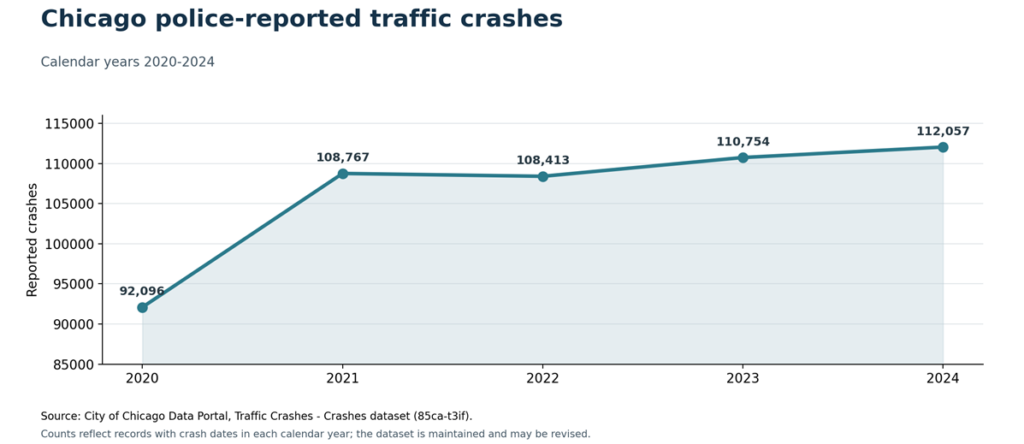
The City of Chicago Traffic Crashes dataset recorded 112,057 crashes with 2024 crash dates. This is 21.7% more than the 92,096 records with 2020 crash dates, but the chart does not explain why the total changed and should not be interpreted as a claim trend.
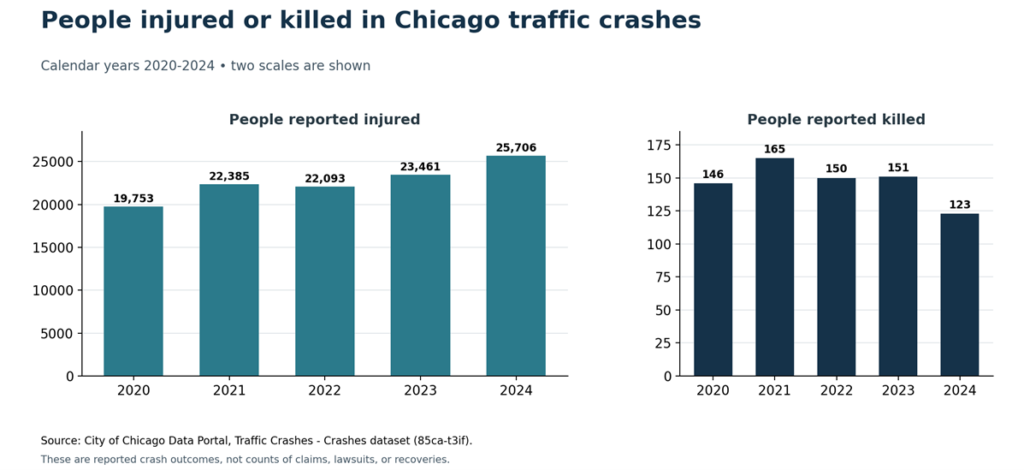
The same city dataset reports 25,706 people injured and 123 people killed in crashes dated during 2024. Injury and fatality totals use separate scales in the figure so both series remain legible.
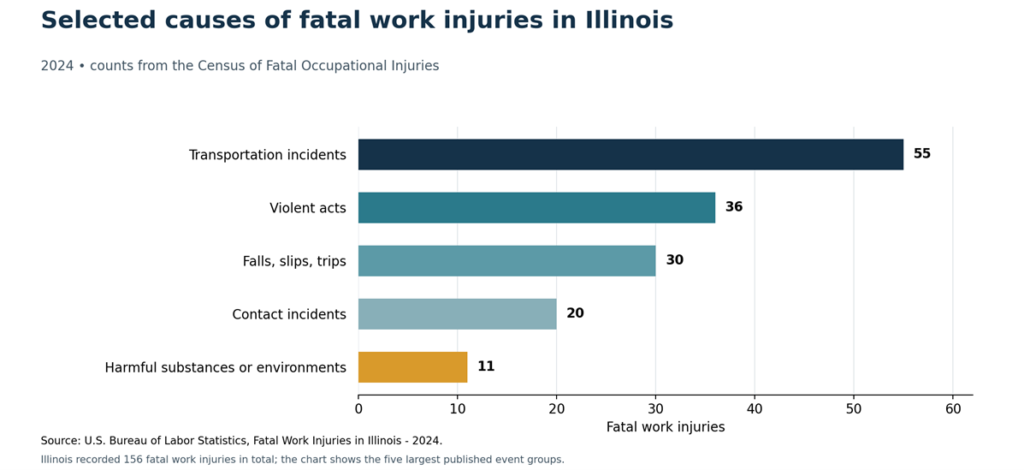
The U.S. Bureau of Labor Statistics Illinois fatal work injury release reports 156 fatal work injuries in 2024. Transportation incidents were the largest event group with 55 deaths, followed by violent acts with 36 and falls, slips, or trips with 30. Workplace injuries may involve workers’ compensation, a third-party personal injury claim, or both; the correct route depends on who caused the harm and the employment relationship.
Summary
A Chicago personal injury claim requires more than proof that an accident occurred. The claimant must identify a valid basis for liability, connect the responsible conduct to the injury, document financial and non-financial losses, and act before the correct deadline. Prompt medical care, accurate reporting, preserved evidence, consistent records, and careful communication with insurers can protect the ability to evaluate the claim. Illinois comparative negligence may reduce or bar recovery depending on the claimant’s share of fault, and special rules may apply to public defendants, medical malpractice, children, workplace injuries, and wrongful death. Settlement value and timing depend on the evidence, injuries, coverage, disputed issues, and litigation risk, so no online calculator or statewide average can reliably decide an individual case.
Additional Questions
Are Personal Injury Settlements Taxable?
Tax treatment depends on what the payment represents. The IRS guidance on settlements and judgments explains that recoveries for personal physical injuries or physical sickness may receive different treatment from punitive damages, interest, wages, or emotional-distress payments not tied to physical injury. Settlement language does not by itself control tax law. A qualified tax professional should review a substantial or mixed-category recovery.
Can I Handle a Personal Injury Claim Without a Lawyer?
A person may handle a claim without counsel, but the practical risk increases with serious injuries, disputed fault, uncertain future care, several defendants, a public entity, limited insurance, subrogation or liens, or an approaching deadline. Before signing a release, compare the available evidence and coverage with the full medical and financial consequences of ending the claim.
What Happens During a Free Consultation?
A consultation usually covers how the injury happened, treatment, insurance, communications, evidence, prior incidents or conditions, potential defendants, deadlines, and the client’s goals. Bring reports, photographs, insurance letters, medical information, and any document requesting a signature. The firm provides a checklist of questions to ask a personal injury lawyer.
Discuss Your Claim With Attorneys of Chicago
If you were injured in Chicago and want to understand your options, Attorneys of Chicago can review how the event occurred, identify potential defendants and insurance, discuss the evidence and deadlines, and explain the next steps. A consultation does not guarantee that a claim will be accepted or that compensation will be recovered.
Contact Attorneys of Chicago for a case evaluation or call (312) 766-4878.
This page provides general information and is not legal advice. Reading it does not create an attorney-client relationship. Legal rules and deadlines should be confirmed for the specific facts of a claim.
